Building Better FinTech Products Starts With Who You Hire
30 April, 2026


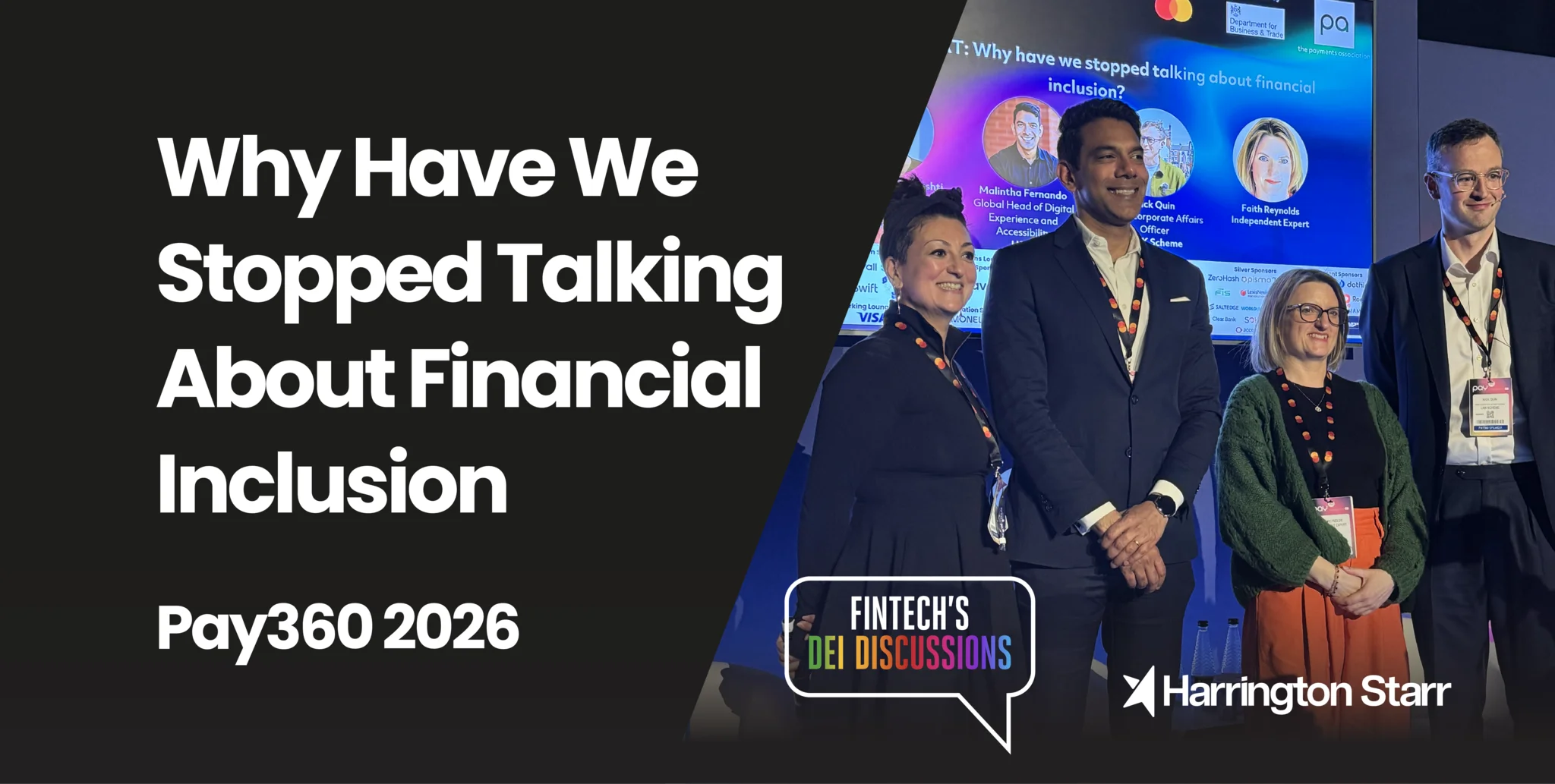
At Pay360 in London, Nadia Edwards-Dashti, Chief Customer Officer at Harrington Starr, moderates a powerful and necessary conversation on a topic that refuses to go away: financial inclusion. Joined by Faith Reynolds, Nick Quin, and Malintha Fernando, this panel challenges a critical assumption in financial services, that progress in digital innovation automatically leads to inclusion.
From the outset, the tone is clear. Financial inclusion is not a solved problem, nor is it a legacy conversation. As Nadia frames it, this is a topic that requires continuous attention, active engagement, and industry-wide accountability. The panel explores not only why the conversation appears to have quietened in some areas, but also why the underlying challenges remain deeply embedded in the structure of modern financial systems.
The discussion quickly moves into the reality of digital transformation in financial services. While innovation in payments, digital banking, and fintech platforms has accelerated, the panel highlights a fundamental tension: the same tools designed to improve access can inadvertently create new forms of exclusion.
Faith Reynolds outlines how the broader environment has shifted. With geopolitical pressures and changing priorities, diversity, equity, and inclusion initiatives have, in some cases, taken a backseat. At the same time, the UK faces a strong push for economic growth, with competition and global positioning driving strategic decisions. Within this context, financial inclusion risks becoming diluted, acknowledged in principle, but lacking clear accountability or measurable outcomes.
She highlights how recent strategies, while well-intentioned, can feel “soft,” creating uncertainty around responsibility and delivery. This shift from regulatory-driven mandates to public-private collaboration places greater pressure on the financial services industry to lead change independently. The question becomes not whether financial inclusion is important, but who is responsible for delivering it, and how.
One of the most compelling parts of the conversation centres on the lived experience of digital banking. Faith Reynolds introduces the concept of a “digital transition,” emphasising that not everyone is moving at the same pace. While many consumers have embraced digital banking, others are struggling to keep up, creating a divide that is often invisible to those designing the systems.
Her research reveals the scale of this challenge. Millions of people are quietly supporting others with basic banking tasks, from checking balances to navigating apps and managing payments. This “hidden” layer of support acts as an unofficial infrastructure, bridging the gap between digital systems and real-world usability.
The reasons behind this reliance are telling. It is not simply a lack of digital skills that creates barriers, but fear, fear of making mistakes, fear of fraud, and a lack of confidence in navigating increasingly complex systems. As security measures become more sophisticated, they also become more intimidating for some users, reinforcing exclusion rather than reducing risk.
This insight is critical for fintech leaders, product designers, and financial services recruitment professionals alike. The challenge is no longer just about building secure systems, but about designing experiences that are both safe and usable for a diverse population.
Nick Quin brings a different but equally important perspective to the discussion through his work with LINK, the UK’s ATM and cash access network. While digital payments dominate industry conversations, cash remains essential for millions of people across the UK.
He highlights a key misconception: that reliance on cash is primarily age-driven. In reality, income is the strongest predictor. For individuals managing tight budgets, cash provides a level of control and certainty that digital payments often cannot replicate. It allows users to track spending in real time and avoid the complexities of delayed transactions or hidden balances.
Despite a decline in overall cash usage, the number of people who depend on it remains remarkably stable. This “sticky” user base underscores the importance of maintaining access to cash as part of a broader financial inclusion strategy. Removing or neglecting this infrastructure risks excluding a significant segment of the population.
Nick also addresses the assumption that digital solutions are universally effective. In environments like Pay360, where attendees are typically comfortable with cashless systems, it is easy to overlook those who are not. This creates a dangerous narrative—that if something works for industry professionals, it must work for everyone.
The reality is far more complex, and the responsibility lies with financial institutions to design systems that cater to a wider range of needs.
Malintha Fernando offers a more optimistic perspective, highlighting the progress being made within global financial institutions like HSBC. His work in digital accessibility demonstrates that inclusion can be embedded into core business strategy rather than treated as a compliance requirement.
HSBC’s approach is rooted in a clear ambition: to become the most digitally accessible bank in the world. This involves not only designing inclusive customer-facing products but also ensuring that internal systems support a diverse workforce. By integrating accessibility into every stage of product development, from design to testing, the bank aims to create experiences that work for all users.
Malintha emphasises that inclusive design benefits everyone, not just those with specific needs. Features such as improved colour contrast, simplified interfaces, and intuitive navigation enhance usability across the board. This aligns with a broader shift in fintech, where accessibility is increasingly recognised as a driver of customer experience and brand differentiation.
Importantly, he also highlights the commercial case for inclusion. With over a billion people globally identifying as disabled or neurodivergent, failing to address accessibility means leaving a significant portion of the market untapped. For fintech companies and financial services recruitment teams, this represents both a risk and an opportunity.
From a recruitment perspective, this conversation has significant implications. As financial services firms invest in digital transformation, the demand for talent with expertise in accessibility, user experience, and inclusive design is growing rapidly.
At Harrington Starr, the focus on connecting businesses with specialists across fintech, data, software engineering, and product management positions the company at the centre of this shift. Building inclusive financial systems requires more than technology, it requires the right people, with the right skills, and the right mindset.
The panel highlights the importance of training and education in this space. Digital accessibility is not widely taught, meaning organisations must invest in upskilling their workforce. HSBC’s efforts to train hundreds of thousands of employees demonstrate the scale of this challenge and the commitment required to address it.
For hiring managers, this creates a clear mandate: prioritise talent that understands not only how to build systems, but how to build them for everyone.
The conversation also explores the role of regulation and innovation in shaping the future of financial inclusion. Nick Quin points to the success of regulatory frameworks in ensuring access to cash, where shared standards and collaboration have delivered consistent outcomes across the UK.
This raises an important question for digital payments: can similar frameworks be applied to ensure inclusive design and accessibility? While innovation is essential, the panel acknowledges that without coordination and accountability, progress may be uneven.
Malintha contrasts the UK’s approach with developments in regions such as Asia and the Middle East, where governments are actively driving accessibility initiatives. From mandatory audits to advanced use of AI, these markets demonstrate a willingness to embrace innovation at scale.
This global perspective serves as both a benchmark and a challenge. For the UK fintech ecosystem, maintaining leadership in financial services will require a renewed focus on inclusion, supported by both industry and regulatory action.
A recurring theme throughout the panel is the need to design financial services around real customer experiences. Faith Reynolds highlights how current systems often fail to reflect the complexity of modern financial lives, particularly for those with irregular incomes or multiple sources of employment.
The rise of the gig economy has introduced new challenges, with income and expenses fluctuating in ways that traditional banking systems are not designed to accommodate. This creates a demand for more flexible payment solutions, improved financial visibility, and greater control over spending.
At the same time, the complexity of digital interfaces, authentication processes, and account management tools can create barriers for users who are already navigating challenging circumstances. Simplifying these experiences is not just a usability issue, it is a critical component of financial inclusion.
As the panel draws to a close, the focus shifts from analysis to action. Each speaker offers a perspective on what needs to happen next, reinforcing the idea that financial inclusion is a shared responsibility.
For organisations, this means embedding inclusion into culture, investing in skills, and committing resources to drive change. For individuals, it involves engaging with diverse perspectives, challenging assumptions, and actively contributing to solutions.
The overarching message is clear: financial inclusion cannot be treated as a side initiative. It must be integrated into the core of fintech strategy, product development, and talent acquisition.
For Harrington Starr and the wider financial services industry, this represents both a challenge and an opportunity. By prioritising inclusive design, investing in talent, and embracing innovation responsibly, the sector can build a financial system that truly works for everyone.